
Let's keep things basic...
...psychological needs

Alright, alright, I know it’s been nearly 2 years since the previous post. At this point, you’ve probably forgotten that you even signed up! I promise this time will be different. I’ve planned out the next 12 monthly briefings. Now, we all know that no plan survives first contact but it’s a start and I can at least commit to some regularity.
Anyway, onwards and upwards. Thought I’d kick this off again by covering some basics of human functioning. Specifically, the role of basic psychological needs in experiences of resilience, performance and psychological health. I’ve always liked the basic needs framework because it nicely distills the human experience into core experiences that predict variability in a lot of outcomes related to how people think, feel and act. The parsimony also very much suits my simple brain (I use the term parsimony ironically because someone once used it in a meeting and I had to Google what it meant under the table).
Professor Richard Ryan defines basic psychological needs as “critical resources underlying individuals’ natural inclination to move towards increasing self-organization, adjustment, and flourishing”. Within basic psychological needs theory, there are three core needs. These are:
Autonomy: feelings of agency, volition and control
Competence: feelings of confidence, effectiveness and mastery
Relatedness: feelings of connectedness, trust and belonging
These experiences have a funny reputation amongst psychologists. I saw this meme on Twitter a while ago and it made me chuckle (no credit unfortunately, but whoever produced it is clearly a genius)…

It is funny, because you can’t dig very far into aspects of human functioning before stumbling across similar ideas. This is why researchers suggest that the psychological needs for autonomy, competence and relatedness are universal constructs that apply across contexts and cultures. And, there is a groundswell of empirical evidence to support that view.
So what’s this got to do with extremes I hear you asking?
Well, these things seem to be important in isolated, confined and extreme settings too. Take a look at the network analysis below. This is based on descriptive data that colleagues and I have been collecting from expedition team members for a number of years now. Here we have daily data from 42 people (nearly 1000 days in total) taking part in different types of expedition journey (crossing polar icecaps, trekking through deserts and so on). The nodes nearer the middle represent stuff that is happening a lot. Lines show the connections between experiences (in the present case, the thicker the lines the greater the co-occurrence).
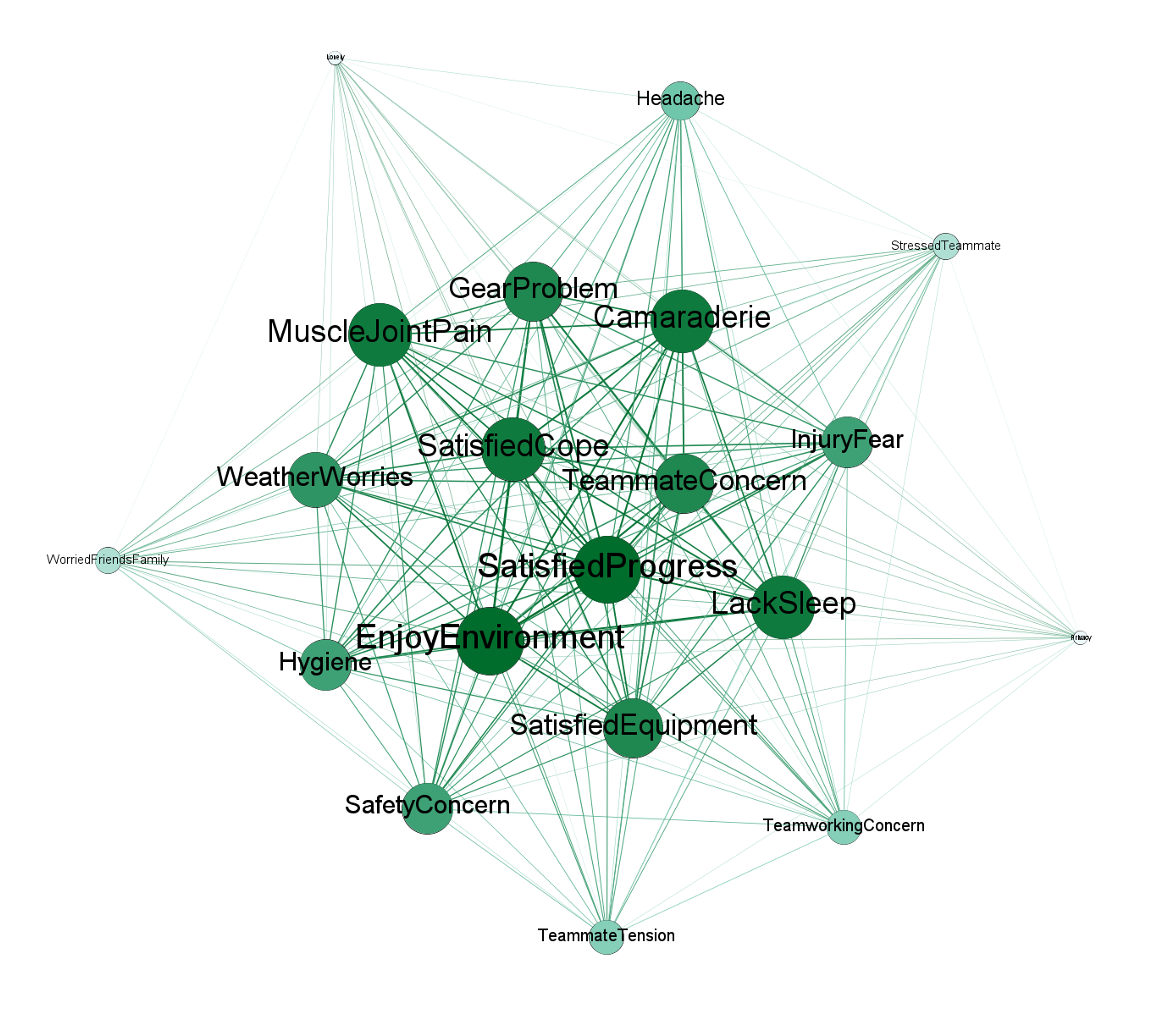
Feeling satisfied in being able to cope, being satisfied with progress, and enjoying camaraderie with others and the environment are very common occurrences on expeditions. These events correspond pretty well to experience of autonomy, competence and relatedness. So, it wasn’t really a surprise when we found that these things were positively associated with markers of healthy functioning in some of our expedition research.
Other people have directly researched how basic psychological needs impact upon functioning in isolated, confined and extreme settings. One of my favourite papers on this topic is by Dr Sophie Goemaere and is entitled ‘Life on mars from a Self-Determination Theory perspective: How astronauts' needs for autonomy, competence and relatedness go hand in hand with crew health and mission success - Results from HI-SEAS IV. Sophie and colleagues were interested in how week-to-week variations in crew members’ reports of basic psychological need satisfaction predicted markers of individual and interpersonal functioning during a year living in an isolation facility simulating a mission to Mars. They found that when crew reported higher weekly ratings of autonomy, competence and relatedness satisfaction, they had higher motivation, were more cooperative and performed better, showed less oppositional defiance, and were less stressed and irritable. Nice findings.
Another paper I very much enjoyed reading recently is by Dr Tracey Devonport and colleagues. Their article ‘Walking on Thin Ice: Exploring Demands and Means of Coping During an Extreme Expedition’ reports on the coping behaviour of two expeditioners as they travelled across Lake Baikal. What I really appreciated was that they approached the topic of coping with a view towards understanding and establishing the goal of regulatory behaviour. This is often missing in studies of coping, especially in the context of extreme environments, which can sometimes leave you wondering why certain approaches might or might not be effective. In their work, Tracey and co used Professor Ellen Skinner’s coping framework which organises regulatory behaviours according to how they shape basic psychological needs. The findings capture the dynamism in how people respond and cope with extreme demands. They also nicely illustrate the benefits of doing things (i.e., self-regulating) to secure feelings of autonomy, competence and relatedness. This research resonates with me because it is something that I/we have been arguing for in recent work. I recently talked a little bit about this in a podcast with the inimitable Dr Dan Dworkis over at The Emergency Mind.
A couple of years ago when I started getting a bit more interested in how digital technologies could be used to support safety, performance and health in extremes I came across the Motivation, Engagement and Thriving in User Experience (METUX) framework by Dr Dorian Peters, Professor Rafael Calvo and Professor Richard Ryan. METUX positions basic psychological needs as central mediators that can help explain the impact that technology has on human health and wellbeing. Their argument is that when technology interfaces, tasks, behaviours and life impacts support feelings of autonomy, competence and relatedness they should have a positive impact upon a person. The METUX framework is very helpful when thinking about how to design and evaluate tools and technologies to support resilience, performance and wellness (read the paper, it is very good).
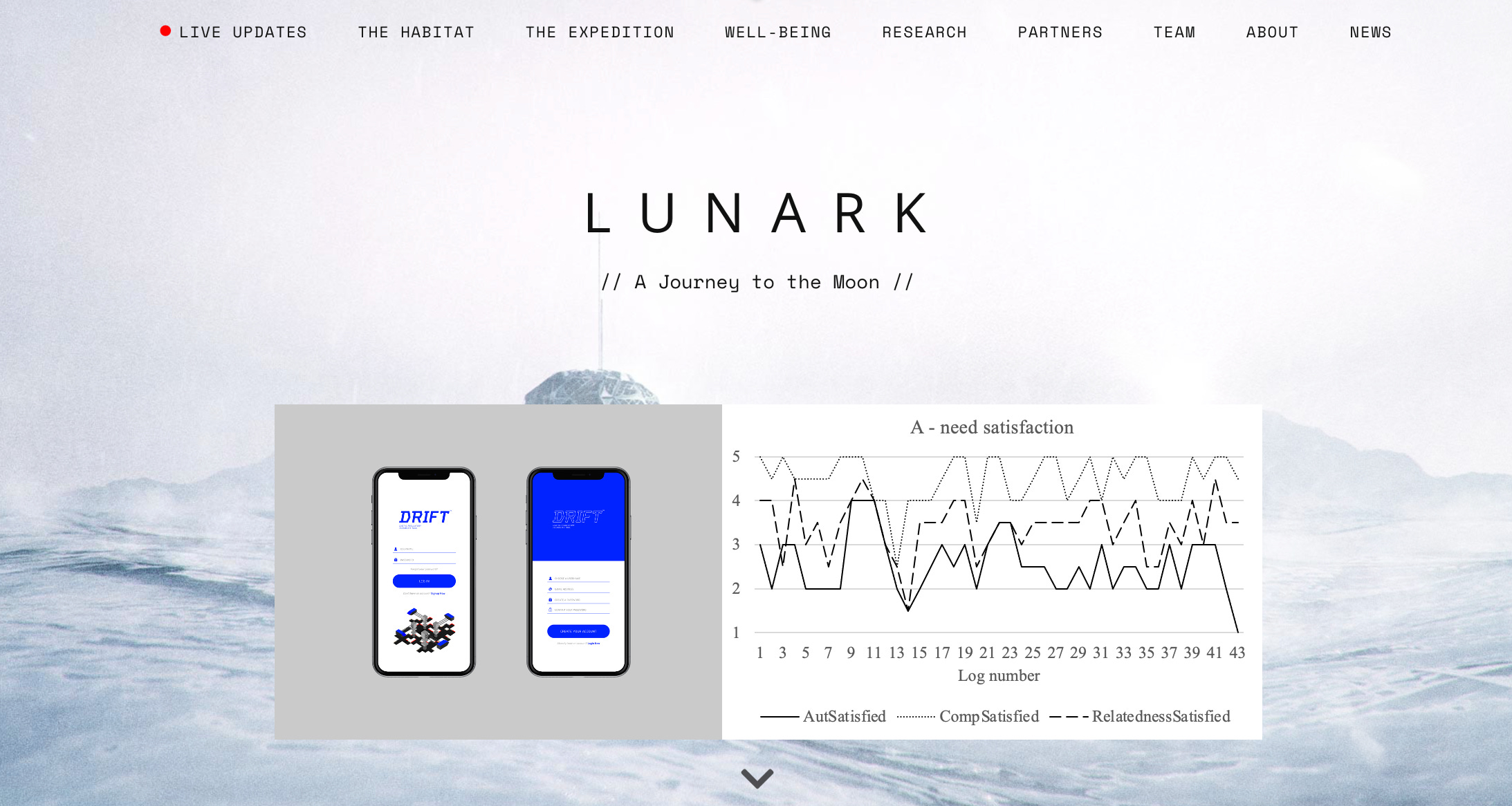
Colleagues and I have actually talked about how the framework could support the design of digital mental health applications for deep space exploration. We’ve also used the ideas to inform the development of the DRIFT app and another app (which should be out fairly soon), both of which have been built to help us gather data on and and attempt to influence basic psychological need experiences of people in extreme settings. Initial field tests of the DRIFT app have been positive and helped us capture daily data on basic need experiences in some pretty remote areas. The following image shows the evolution in autonomy, competence and relatedness satisfaction for one crew member across a 60-day lunar analog mission in Arctic Greenland (read more about the LUNARK mission here). As you can see, there were lots of ups and downs for this person! It we can use technology to sustain and enhance the basic psychological need satisfaction of people operating in these types of environment it will likely have benefits for safety, performance and health.
I could go on and on, but I don’t want to sound too much more like a travelling salesman for basic psychological needs theory (Deci, Ryan, I’ll expect my 4/5ths commish in the post…). So, that’s it for now. The next one will be the first of a new ‘Biomarker briefing’, which will be a regular feature dedicated to exploring neurophysiological markers of resilience, performance and well-being. I’ll be bringing my best Doc Brown game for those.

Whilst you wait for the next instalment, you can support my basic psychological need satisfaction by subscribing, liking and sharing this joyous little foray into the world of psychology and thriving in extremes with others.